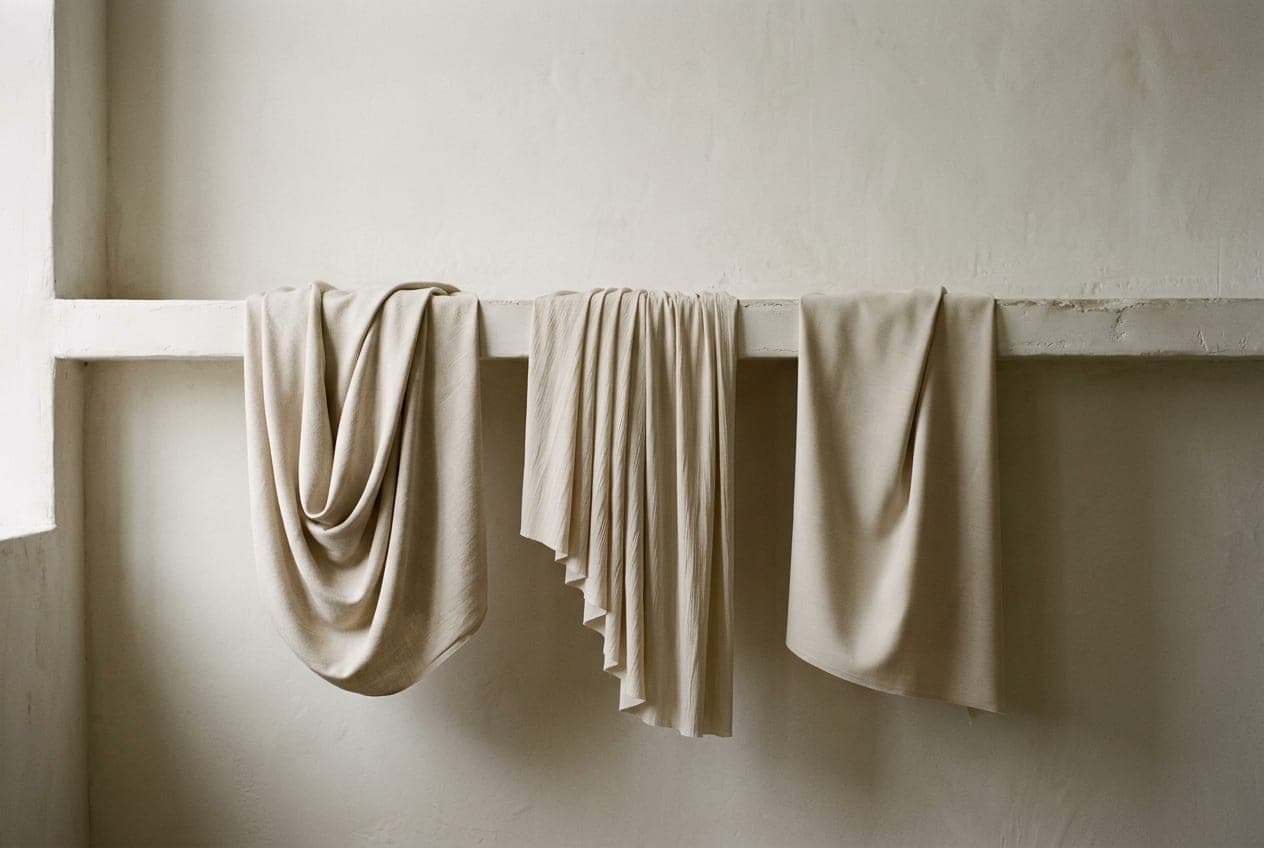
Viscose, modal, cupro, lyocell, rayon, bamboo. These turn up constantly on labels for slip skirts, fluid trousers and drapey shirting, and most people treat them as interchangeable. They are not.
All of them are semi-synthetic: made from natural cellulose — usually wood pulp or cotton waste — that has been chemically dissolved and re-spun into fibre. That is why they feel closer to natural fibres than polyester does, while behaving quite differently from cotton.
The differences between them come down to how they are processed, and the processing changes three things you will actually notice: how they drape, how they cope with water, and how long they look new.
Viscose
The original and the most common.
- Drape: excellent. Fluid and heavy in a way that hangs beautifully.
- Feel: soft, cool, slightly matte.
- Weakness: it loses a significant amount of strength when wet. This is the single most important thing to know about it. A wet viscose garment stretches, and a hot machine wash can shrink it unevenly and permanently.
- Wear: wrinkles fairly readily, can pill at friction points.
Buy it for: slip skirts and dresses, fluid wide-leg trousers, anything where hang is the whole point and you are prepared to wash it cold or hand wash.
Modal
Viscose taken a step further — the fibres are stretched during production, which makes them longer and stronger.
- Drape: very good, slightly lighter and springier than viscose.
- Feel: noticeably smoother and more lustrous. Modal is the reason good jersey tees feel expensive.
- Strength: much better than viscose, wet or dry. It survives normal washing.
- Wear: resists pilling well and holds colour through repeated washes better than viscose.
Buy it for: jersey tees, loungewear, underwear, drapey knitwear, anything that will be washed often. If you are choosing between a viscose tee and a modal tee at similar prices, take the modal.
Cupro
Made from cotton linter — the short fibres left on the seed after ginning — dissolved in a copper-ammonia solution.
- Drape: the best of the three. Genuinely close to silk in the way it moves.
- Feel: smooth, cool to the touch, with a subtle sheen.
- Strength: better than viscose, and it can usually be machine washed cold, which silk cannot.
- Weakness: expensive, and often used as a lining rather than an outer fabric, which means you meet it without noticing.
Buy it for: anything you want to behave like silk without the care burden. Slip dresses and blouses are where it earns the price difference.
Lyocell, rayon and bamboo, briefly
Lyocell — often seen under a brand name — is made in a closed-loop process that recovers and reuses the solvent, so it has the strongest environmental case of the group. It is strong wet and dry, drapes well and resists wrinkling better than viscose. If you see it, it is generally the sensible choice.
Rayon is not a separate fibre. In UK and European labelling it is essentially another word for viscose, and in the US it is used as an umbrella term. Read it as viscose.
Bamboo on a label almost always means bamboo viscose — bamboo pulp put through the viscose process. It behaves like viscose, because it is viscose. Treat any claim that it is naturally antibacterial with scepticism; the chemistry of the process does not leave much of the original plant behind.
The short answer
| Drape | Wet strength | Washing | Cost | |
|---|---|---|---|---|
| Viscose | Excellent | Poor | Cold, careful | Low |
| Modal | Very good | Good | Normal | Medium |
| Cupro | Best | Good | Cold machine | High |
| Lyocell | Very good | Very good | Normal | Medium to high |
If you want one rule: modal for things you wash a lot, cupro for things you want to look expensive, viscose when the drape matters more than the upkeep, and lyocell when you can find it.
Reading it on the label
None of this helps if you do not check. Reading a composition label in ten seconds covers the rest of the label — the first-number rule, pilling risk, and what elastane is doing in there.