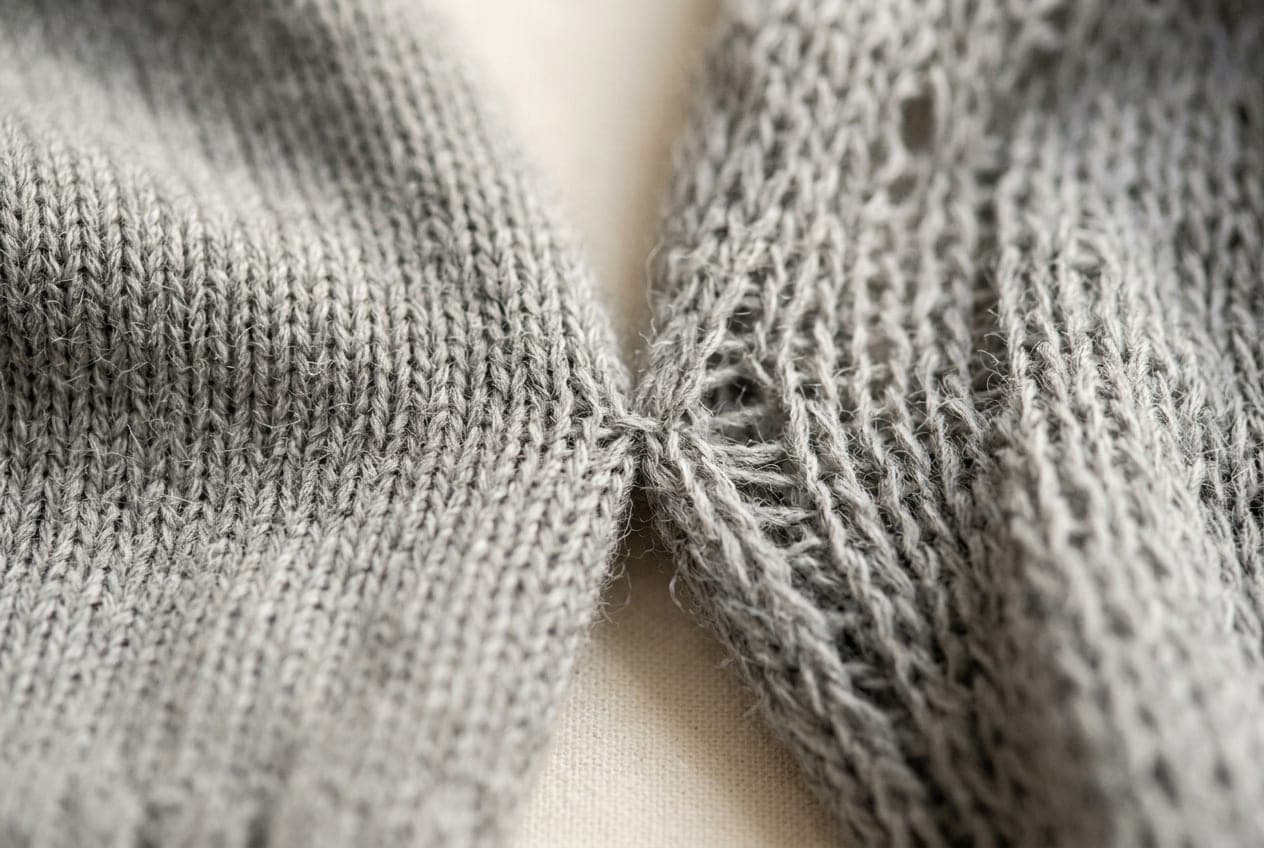
Two jumpers can carry the same composition label and behave completely differently. The label tells you what the fibre is; it says nothing about the length of the fibre, how it was spun, or how densely it was knitted — and those decide almost everything.
Five checks, none of which need any expertise.
1. Hold it up to the light
The most informative thing you can do in ten seconds.
A densely knitted garment blocks the light. A loose, thin one lets it through, and where you can see gaps you will eventually see wear.
Density is where the yarn cost is. A thin knit is thin because less yarn was used, and it will lose its shape and pill sooner. Some fine knits are deliberately sheer, which is a design decision rather than a shortcut — but for anything sold as a warm jumper, opacity is quality.
2. Rub it between your fingers
Rub a small area briskly for a few seconds.
If fuzz appears immediately, the fibres are short and it will pill. Long-fibre yarn holds together under friction. This is why two cashmere jumpers at very different prices are genuinely different products despite identical labels — how to remove bobbles covers the consequence.
Be suspicious of remarkable softness in a cheap knit. That softness is often a brushed surface of short fibres, and it is exactly what turns into bobbles within a month.
3. Stretch it and let go
Pull gently across the body and release.
Good yarn springs back. Poor yarn stays stretched, which is what happens to elbows, cuffs and hems over a season. Do the same at the cuff specifically, since that is where the failure shows first and earliest.
4. Check the ply
Ply is the number of strands twisted together. It is rarely on the label and it is usually visible.
Single-ply yarn is one strand — light, and prone to holes. Two-ply and above is denser, stronger and holds shape far better. A two-ply garment at a higher price is often genuinely better value than a single-ply one at half.
Look closely at the knit surface: you can usually see whether a stitch is made of one strand or two twisted together.
5. Look at the seams and finishing
Turn it inside out.
- Fully fashioned seams, where panels are knitted to shape and joined stitch to stitch, are the marker of a good garment. They lie flat and do not fray.
- Cut and sewn, where shapes are cut from knitted fabric and overlocked, is cheaper and more prone to unravelling at the edge.
- Check the ribbing at cuffs and hem — it should be tight and springy, since it is the first thing to go.
What the label does still tell you
Composition matters, it just is not sufficient. Broadly: merino wool is the best value in everyday knitwear; lambswool is warm and hard-wearing; cashmere is soft and warm and only as good as its fibre length; acrylic pills badly and does not breathe.
Reading a composition label covers the rest of what the percentages predict.
Then look after it
A well-made knit lasts fifteen years and a badly-treated one lasts two, regardless of price. How to wash cashmere covers hand washing and how to store knitwear covers the summer, which is when most damage actually happens.